// CASE STUDY — Developer Tools
ConverterHub
Solo design, build, and operation
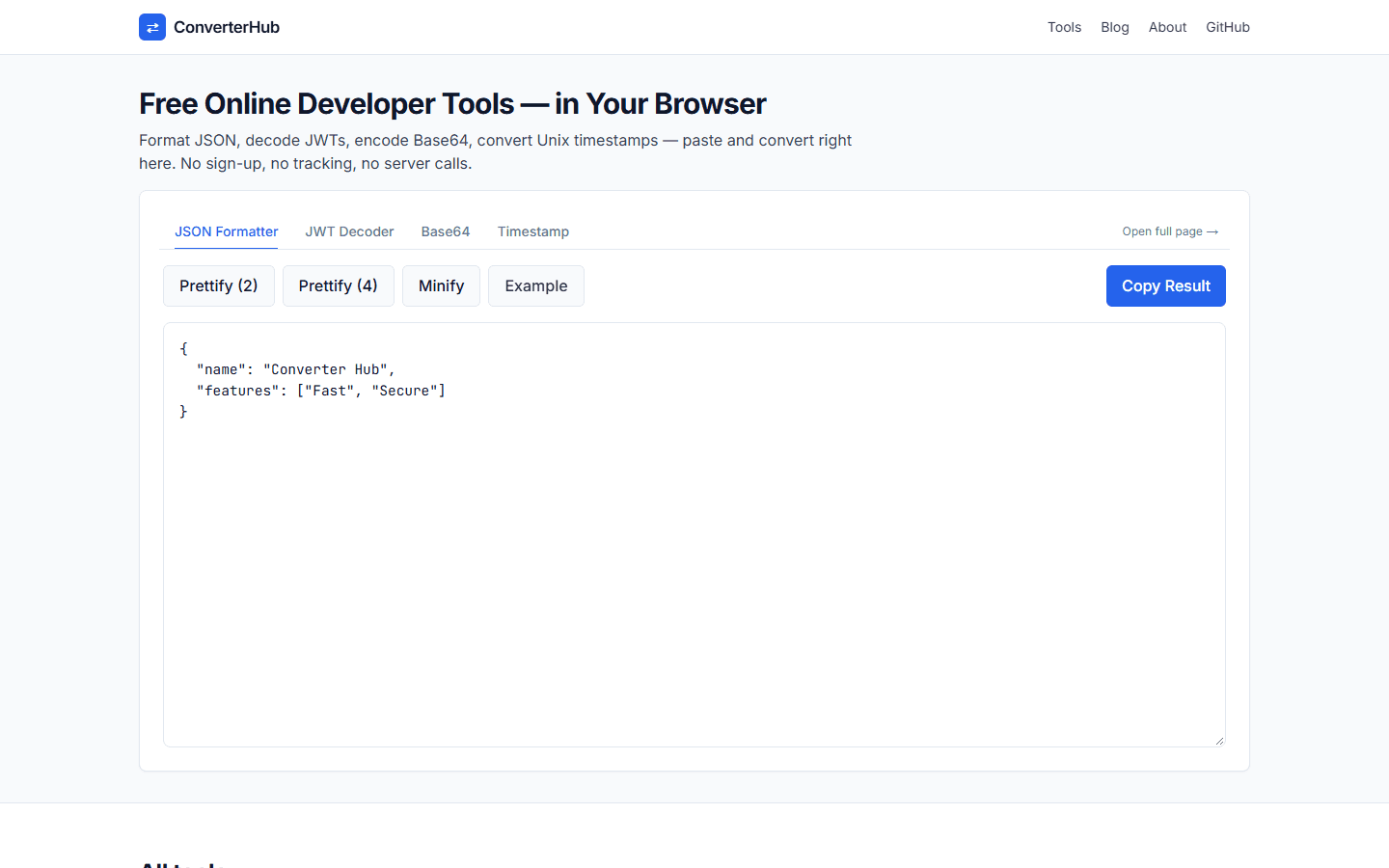
Browser-based tools for JSON, timestamps, Base64, CSV, and everyday developer tasks. Conversion inputs are processed locally, with no account required.
Problem
Developers and analysts need quick conversions without uploading the content they paste to a processing service.
My Contribution
I designed, built, and maintain the utility site, shared conversion logic, and individual tool pages.
Key Decisions
Execute conversions in the browser, statically generate tool pages, and test conversion logic with Vitest.
Results
A live collection of developer utilities at converterhub.dev, with public source code and client-side conversion workflows.
Behind the Build
ConverterHub is the tool site I wanted during on-call work: paste in a Unix timestamp, a JSON blob, or a Base64 string and get an instant answer without wondering where the data goes. It lives at converterhub.dev and bundles the everyday conversions developers and analysts reach for — timestamp ↔ date, JSON formatting and validation, JSON ↔ CSV, Base64 and URL encoding/decoding, case conversion, word/character counting, and text-to-SQL IN lists.
The defining decision was to execute conversions client-side in the browser, rather than sending conversion inputs to a processing service. No accounts, no login, no database, no server-side processing; this limits the conversion data held by the developer, while device security and the code delivered to the browser still matter. As someone who reviews web apps for a living, I wanted a site where the honest answer to 'what do you do with my data?' is 'nothing — we never receive it.'
The build itself is a lean Next.js App Router site: statically generated tool pages for speed and SEO, vanilla CSS with dark/light theming instead of a framework, a Vitest suite over the conversion logic, and per-tool metadata so each utility ranks for its own high-intent search query.
Built With
Highlights
- Everyday utilities in one place: timestamp conversion, JSON formatting and validation, JSON ↔ CSV, Base64 and URL encoding, JWT inspection, UUID generation, HTML entity conversion, and word counting.
- 100% client-side execution — conversions run in the browser, so pasted data (often production data or tokens) never reaches a server.
- No-login by design: no accounts, no database, no tracking of tool inputs — the privacy guarantee is architectural, not a policy promise.
- Statically generated tool pages with per-tool SEO metadata, each targeting its own high-intent search query.
- Vitest suite over the conversion logic, with edge cases documented in a running decisions log.
- Minimal JS bundle and vanilla-CSS theming (dark/light) — fast enough to be the tab you keep pinned.
Security Considerations
- Conversion inputs are processed in the browser rather than uploaded to a backend. This reduces server-side exposure but does not remove risks from compromised devices, extensions, dependencies, or delivered code.
- The conversion workflow does not send pasted tokens, exports, or customer records to a processing service; users should still follow their organisation's rules for sensitive data.
- No third-party scripts in the conversion path, keeping the supply-chain surface of a paste-sensitive tool minimal.
Development Timeline
Stack & Privacy Decisions
Jan 2025Chose Next.js + TypeScript with vanilla CSS, and made the defining call recorded in the decisions log: no database, all tools client-side only — privacy, low latency, zero backend cost.
Core Tool Build
Jan 2025Built the first wave of converters — timestamps, JSON formatting/validation, Base64/URL, case conversion — as statically generated pages sharing one conversion-engine pattern.
Launch on converterhub.dev
Feb 2025Shipped to Vercel on a custom domain with dark/light theming, per-tool metadata, sitemap, and a Vitest suite over the conversion logic.
Analyst Tools
Apr 2025Added the JSON ↔ CSV converter, word/character counter, and text-to-SQL IN list — the requests that kept coming from data-analyst workflows.
Content & Upkeep
Jun 2026Added about, privacy, and blog pages, refreshed dependencies, and kept the bundle lean — the site stays fast enough to live as a pinned tab.